Atlas 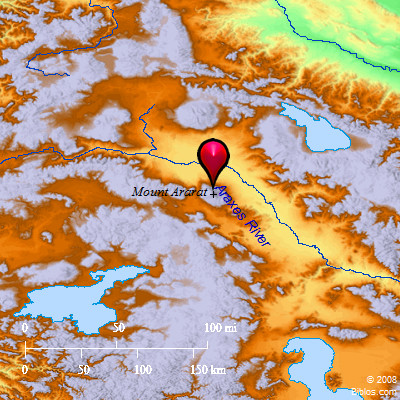 Ararat and surrounding area Maps Created using Biblemapper 3.0 Additional data from OpenBible.info Occurrences 2 Kings 19:37 It happened, as he was worshipping in the house of Nisroch his god, that Adrammelech and Sharezer struck him with the sword; and they escaped into the land of Ararat. Esar Haddon his son reigned in his place.Isaiah 37:38 It happened, as he was worshipping in the house of Nisroch his god, that Adrammelech and Sharezer his sons struck him with the sword; and they escaped into the land of Ararat. Esar Haddon his son reigned in his place. Jeremiah 51:27 Set up a standard in the land, blow the trumpet among the nations, prepare the nations against her, call together against her the kingdoms of Ararat, Minni, and Ashkenaz: appoint a marshal against her; cause the horses to come up as the rough canker worm. Encyclopedia ARARATar'-a-rat ('araraT): A mountainous plateau in western Asia from which flow in different directions the Euphrates, the Tigris, the Aras and the Choruk rivers. Its general elevation is 6,000 feet above the sea. Lake Van, which like the Dead Sea has no outlet, is nearly in its center. The Babylonian name was Urartu, the consonants being the same in both words. In 2 Kings 19:37 and Isaiah 37:38 the word is translated in the King James Version Armenia, which correctly represents the region designated. It was to Armenia that the sons of Sennacherib fled. In Jeremiah 51:27 Ararat is associated with Minni and Ashkenaz, which according to the Assyrian monuments lay just to the east of Armenia. In Genesis 8:4 the ark is said to have rested "upon the mountains of Ararat," i.e. in the mountainous region of Armenia, the plural showing that the mountain peak known as Ararat was not referred to. This peak is of volcanic origin and lies outside the general region, rising from the lowlands of the Araxes (Aras) River to a height of 17,000 feet, supported by another peak seven miles distant, 13,000 feet high. It is only in comparatively modern times that the present name has been given to it. The Armenians still call it Massis, but believe, however, that Noah was buried at Nachitchevan near its base. AR'ARAT, the Scriptures no where speak of a Mt. Ararat, but of the mountains of Ararat. The name Ararat is found in the English bible only in Gen. 8:4, Jer. 51:27, but in the Hebrew it occurs in Isaiah 37:38 although translated Armenia and so also in 2 Kings 19:37. In the latter passage the event described took place in Armenia as we know from other history. Ararat is only another name for Armenia which was one of three ancient associated kingdoms as Jer. 51:27 shows. No particular mountain was specified in Scripture, and that mountain now pointed out in Armenia, 500 ms. n. of Babylon, and called Mt. Massis by the Armenians, and Mt. Ararat by travelers, seems first to have been announced as the mount Ararat by one Rubruquis, a traveler, in about Asher Dan 1250, as Bochart says. This opinion seems to have been derived from St. Jerome. But more ancient writers, as Berosus and the Chaldee paraphrast Jonathan with other historians and early commentators, think that the high range, 50 ms. n. of Nineveh, is the true resting place of the Ark, in Armenia. Mt. Massis is 17,750 ft. above the sea and rises from a plain at the e. end of a range of many miles in length. The older claimant, of which we have just spoken, is called Mt. Kudur, the meaning of this word being "the great ship." ARME'NIA, see Ararat. Anciently it was associated with Ararat; the Assyrian monuments show that the country into which the sons of Sennacherib escaped, see 2 Kings 19:37, was Armenia, but called Ararat in the Hebrew. It is a high mountainous land beginning 50 ms. n. of Nineveh with several high mountain ranges, w. of the Caspian. In very ancient times, Jer. 51:27, there were three kingdoms and the entire district was, probably, called Togarmah. It was, as a whole, bounded w. by the upper Euphrates; e. by the lower part of the Caspian; s. by lat. 36 50' and n. by lat. 41 40'. Strong's Hebrew H780: Ararata district in E. Armenia |
    |